

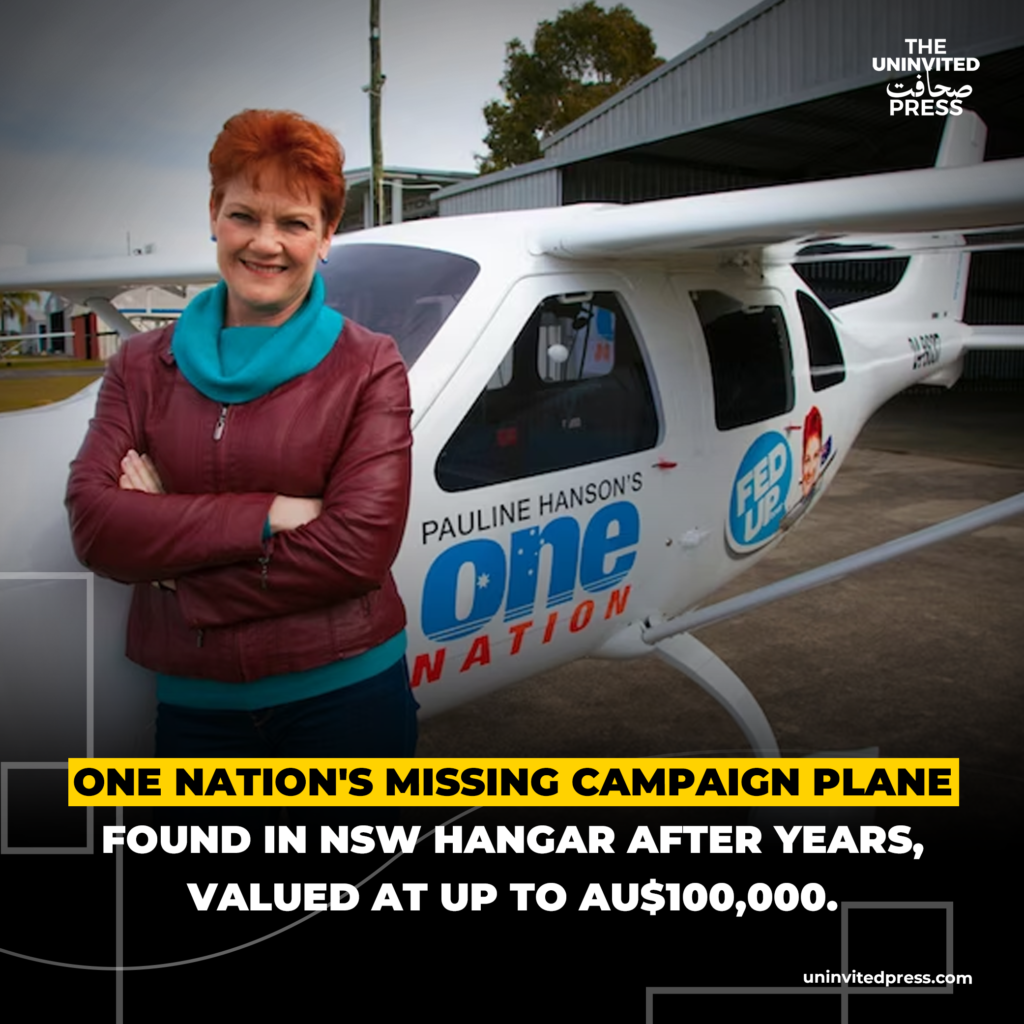
Discovery of Jabiru 230D raises fresh questions over party finances and handling of donor-funded assets after more than a decade.
A light aircraft once used by Pauline Hanson’s One Nation for election campaigning has been located in a locked hangar in the far-western New South Wales outback city of Broken Hill, ending years of uncertainty over its whereabouts. The Jabiru 230D, valued at between about A$80,000 and just over A$100,000, was sold by the party’s national director to a private pilot, an investigation by the Australian Broadcasting Corporation has confirmed.
The plane, registered with the tail number 24-8637, sits in a hangar previously used by a now-closed flight school at Broken Hill Airport, roughly 1,000 kilometres west of Sydney. Locals told investigators it had been kept there for more than five years. Its current operator, a state public servant with no apparent links to One Nation, declined to discuss how he acquired it or any contact with party figures.
One Nation’s national director, James Ashby, who holds a pilot’s licence, confirmed he sold the aircraft to a New South Wales pilot. When asked whether he received the sale proceeds, he responded with a thumbs-up emoji. He said he had contacted Victorian businessman Bill McNee-who provided the funds to purchase the plane more than a decade ago-to seek permission before the sale. Ashby did not disclose the sale price.
One Nation’s Missing Campaign Plane Sparks Ownership Questions:
The Jabiru first appeared in 2015, painted with Hanson’s image, the One Nation logo and the slogan “Fed Up.” Ashby and Hanson used it to reach remote communities during the federal election campaign. Hanson publicly expressed gratitude for the aircraft’s role in connecting with voters outside major centres.
Its ownership and funding quickly became contentious. Victorian property developer Bill McNee supplied the money for the purchase. The plane was registered in Ashby’s name. In 2017, the ABC’s Four Corners programme reported allegations that the arrangement had not been properly declared as a political donation to the Australian Electoral Commission (AEC). McNee initially denied involvement to the programme.
The AEC investigated. Amended returns followed: Ashby declared a donation-in-kind for flight hours valued at A$30,375, while a development company linked to McNee lodged disclosures including A$98,175 described as approximately the cost of the aircraft. The commission later concluded that the relevant disclosures had been made. Questions about legal ownership and eventual disposal of the plane nevertheless persisted. By 2018 the aircraft had been stripped of most party branding; it later appeared in plain white at Gunnedah Airport before being traced to Broken Hill.
One Nation’s Plane Sale Raises Political Donation Questions:
The discovery comes as One Nation’s financial arrangements face continued scrutiny. In September 2026 the party declined to answer questions from The Sydney Morning Herald about the plane’s location or whether it had been sold. Earlier this year, mining magnate Gina Rinehart gifted One Nation the use of a far more expensive Cirrus SR22 aircraft valued at around A$1.5 million, highlighting the contrast between the modest earlier campaign tool and more recent high-profile support.
Critics argue the saga illustrates ongoing issues with political donation transparency in Australia. Assets acquired with donor funds, registered in individual names, and later sold with proceeds flowing to party officials can obscure the full picture of how money moves through political organisations. One Nation has long positioned itself as an outsider party demanding accountability from the major parties; the handling of this aircraft invites reciprocal examination.
Ashby’s confirmation that he received the sale proceeds, combined with the plane’s original funding pathway through McNee, leaves open questions about whether those funds were treated as party resources, personal income, or something in between. Efforts to contact McNee for comment were unsuccessful.
The Jabiru itself is a relatively modest light sports aircraft. Its market value, according to recent comparable listings, sits in the A$80,000-A$100,000 range. Yet its symbolic weight is larger: it represents both the improvisational early years of One Nation’s modern revival and the persistent difficulties Australian politics faces in tracking the full lifecycle of political donations and assets. For now, the plane rests quietly in an outback hangar, its campaign colours long gone. The questions surrounding how it was acquired, used, sold and accounted for remain very much airborne.