

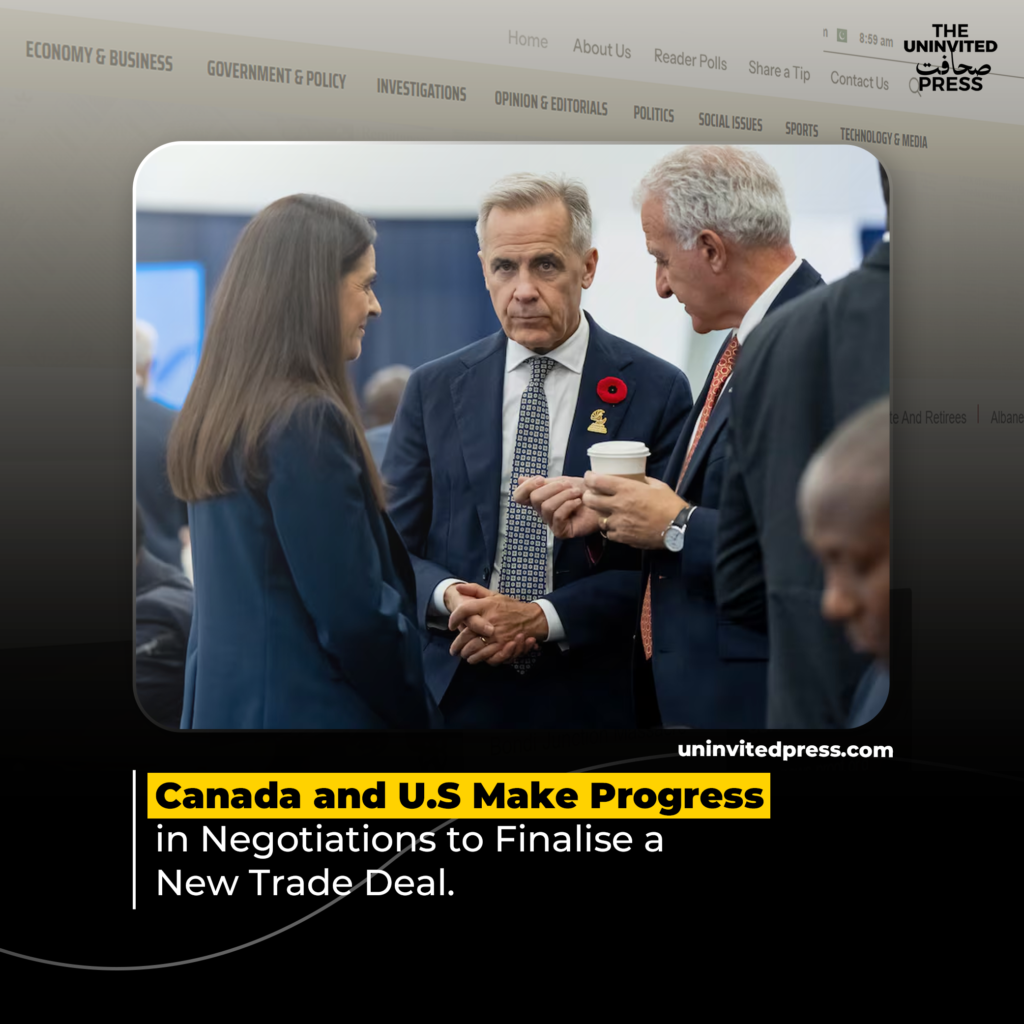
Canadian prime minister reports lengthy talks with Trump after earlier collapse of negotiations; tariffs remain in place as Ottawa pursues Asian partnerships.
Canadian Prime Minister Mark Carney said on Saturday that he has held lengthy and substantive discussions with US President Donald Trump, with the two countries making progress toward a bilateral trade deal, though no agreement has yet been reached.
Speaking from Manila, where he is attending Association of Southeast Asian Nations (ASEAN) meetings and conducting a state visit, Carney told reporters that the talks involved Trump as well as US Trade Representative Jamieson Greer and White House Chief of Staff Stephen Miller. “We are making progress. There is the possibility of a deal, a bilateral deal. But we’re not yet there,” he said.
In the wake of that breakdown, the United States imposed 50 percent tariffs under Section 338 of the Tariff Act of 1930 on roughly $20 billion worth of Canadian goods, including dairy, alcohol and certain auto-related products. Canada responded with counter-tariffs that took effect in early September.
US and Canada Near New Trade Deal Amid Tariff Talks:
US officials have confirmed recent contacts. Greer said this week that American and Canadian teams had discussed a potential deal in the past few days but declined to set any timeline, stressing that “the substance of the deal is more important than a timeline.” Washington’s stated priority remains protecting US supply chains, while Ottawa has sought a return to more open cross-border trade.
Earlier statements from both sides indicated some movement. Carney previously noted that the US had eased certain demands related to Canadian culture, French-language protections and Ottawa’s freedom to negotiate trade agreements with third countries. Trump had said before the US midterm elections that the two countries were “very close” to an agreement.
A deal could ease tariffs on key sectors such as steel, aluminium and automobiles, which form a major part of the deeply integrated North American economic relationship-one of the largest bilateral trading partnerships in the world.
Canada Expands Trade Ties Beyond US Amid Tariff Disputes:
While engaging Washington, Carney highlighted Canada’s parallel efforts to reduce economic dependence on its southern neighbour. He announced that Canada had substantially concluded free-trade negotiations with ASEAN, a bloc of nearly 700 million people, and completed separate talks with the Philippines.
Canadian officials estimate the ASEAN agreement could add nearly 2 billion Canadian dollars ($1.4 billion) to the economy and create almost 14,000 jobs, particularly in agriculture and manufacturing. The Philippines deal would cover more than 90 percent of tariff lines. Both are expected to be signed next year.
The developments unfold against a shifting political backdrop in Washington following the November 3 midterm elections, in which Republicans lost control of both the House and Senate. US Ambassador to Canada Pete Hoekstra has suggested a deal remains possible before the end of 2026, though no firm timetable has been set by either side.
Carney’s government has repeatedly insisted that any agreement must serve Canadian interests. With tariffs still in force and talks continuing without a breakthrough, both capitals appear to be balancing the economic costs of prolonged friction against the political and strategic value of stabilising their relationship.