

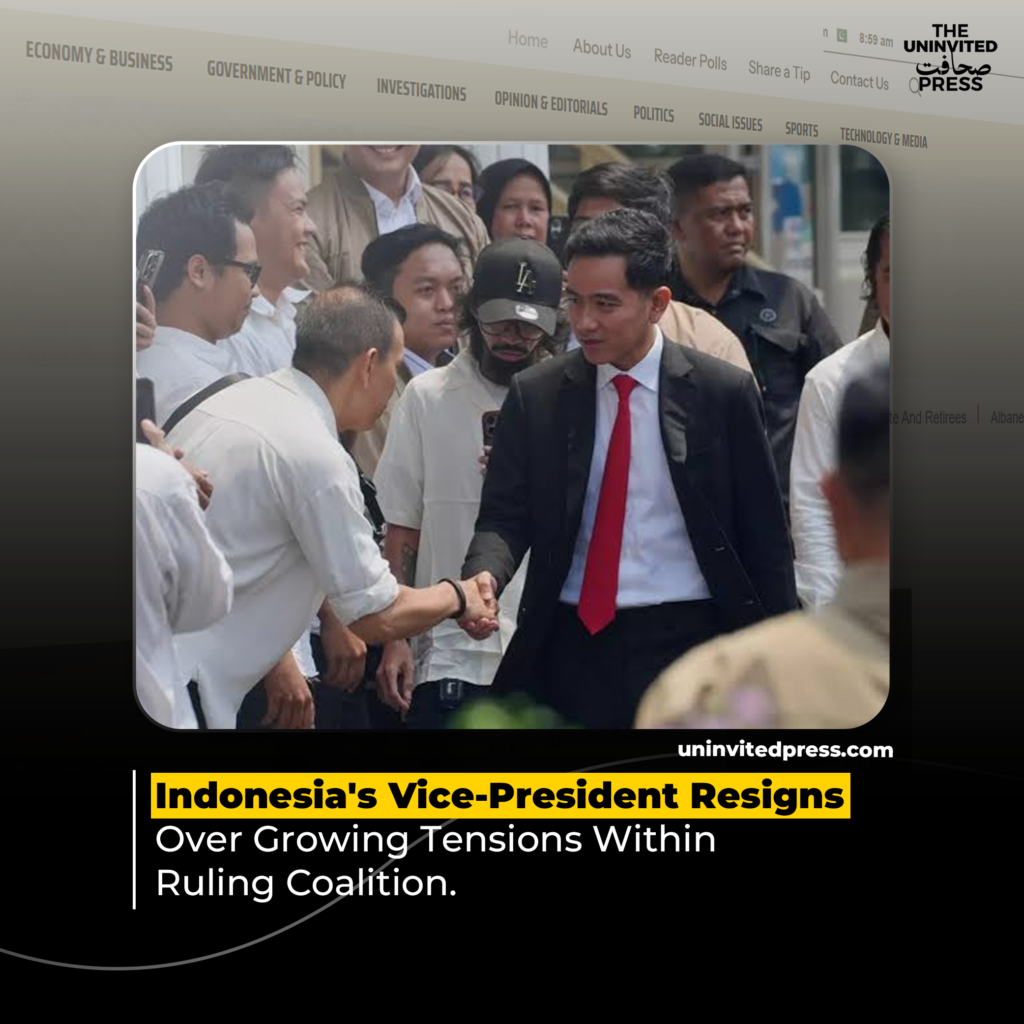
Gibran Rakabuming Raka, son of former President Joko Widodo, steps down after court rulings on his educational credentials and as cracks appear in the Prabowo-Jokowi alliance.
Indonesia’s Vice-President Gibran Rakabuming Raka formally resigned on Thursday, November 12, 2026, ending a tenure of just over two years amid mounting pressure over his educational qualifications and signs of strain within the ruling political coalition. The 39-year-old, the eldest son of former President Joko “Jokowi” Widodo, submitted his resignation letter to President Prabowo Subianto and the People’s Consultative Assembly (MPR), the country’s highest legislative body.
Prabowo Accepts Gibran’s Resignation Amid Political Tensions:
The resignation followed rulings last month by Indonesia’s Constitutional Court and Supreme Court that the documents Gibran submitted regarding his overseas education did not meet the legal requirements for vice-presidential candidates. Indonesian law requires candidates to have completed senior high school or an equivalent qualification. Critics had long accused him of never properly obtaining a high school diploma, and the Supreme Court annulled his overseas high-school equivalency certificate on October 30.
Gibran, who studied in Singapore and Australia before earning a bachelor’s degree through a Singapore-based institute, maintained that his documents were complete. A petition signed by 120 lawmakers from eight political parties was submitted to House of Representatives leaders on Wednesday, beginning a parliamentary process that could have led to impeachment proceedings. Under Indonesian law, such a process involves a special committee and, if warranted, a referral to the Constitutional Court.
Gibran described the decision as personal and unrelated to the diploma controversy. “This decision to step down is also not a declaration of inability. Rather, it is a major step that I must take to preserve the government’s capacity to move forward further,” he said, adding that democracy needs better management.
Speaking alongside Gibran at a press conference at the Presidential Palace in Jakarta, Prabowo said he accepted the resignation “with a heavy heart.” He praised Gibran for showing courage, responsibility and a “chivalrous attitude,” noting his work visiting dozens of provinces and inspecting government projects over two years. “I felt assisted. He did his job well,” Prabowo stated.
From his hometown of Solo in Central Java, Jokowi called political dynamics normal and reminded his son that public office is temporary. “We will continue to support President Prabowo’s government, especially programmes that serve the interests of the broader public,” the former leader said. The public expressions of support came even as analysts pointed to a fraying alliance that had been crucial to the 2024 election victory of the Prabowo-Gibran ticket.
Gibran’s Exit Puts Indonesia’s Ruling Coalition to the Test:
Gibran’s departure is the highest-profile resignation of its kind since President Suharto stepped down in 1998. It occurs against a backdrop of public dissatisfaction with the economy, corruption concerns, and the government’s handling of widespread wildfires. Recent protests have targeted perceived authoritarianism and economic hardship, while a separate wiretapping scandal involving officials close to the administration has added to political turbulence. The rupiah has also come under pressure.
The vice presidency carries limited formal powers-primarily representing the president and succeeding in cases of incapacity-but Gibran’s role symbolized the power-sharing arrangement between Prabowo, a former general, and the popular Jokowi. Signs of tension had emerged earlier, including limited progress on Jokowi’s signature new capital project and reports that Jokowi was disappointed by the lack of strong coalition defense of his son amid the credentials controversy.
Under the Indonesian Constitution, a vice-presidential vacancy does not trigger a fresh election. The MPR has up to 60 days to elect a replacement from two candidates nominated by the president. MPR Speaker Ahmad Muzani confirmed the post is now vacant and said leaders would convene to set timelines, request nominations, and prepare verification procedures. President Prabowo is expected to submit two names within a shorter window once formally requested.
The choice of successor will test coalition cohesion. Analysts suggest Prabowo may favor a political heavyweight to broaden support or a loyalist to consolidate control. While Jokowi has publicly reaffirmed backing for the administration, the exit of his son is widely viewed as a significant shift that could reduce the former president’s influence and open new bargaining among parties in the governing alliance. The episode underscores the fragility of elite pacts in Indonesian politics as the government navigates economic pressures and public scrutiny ahead of the remainder of its term ending in 2029.