

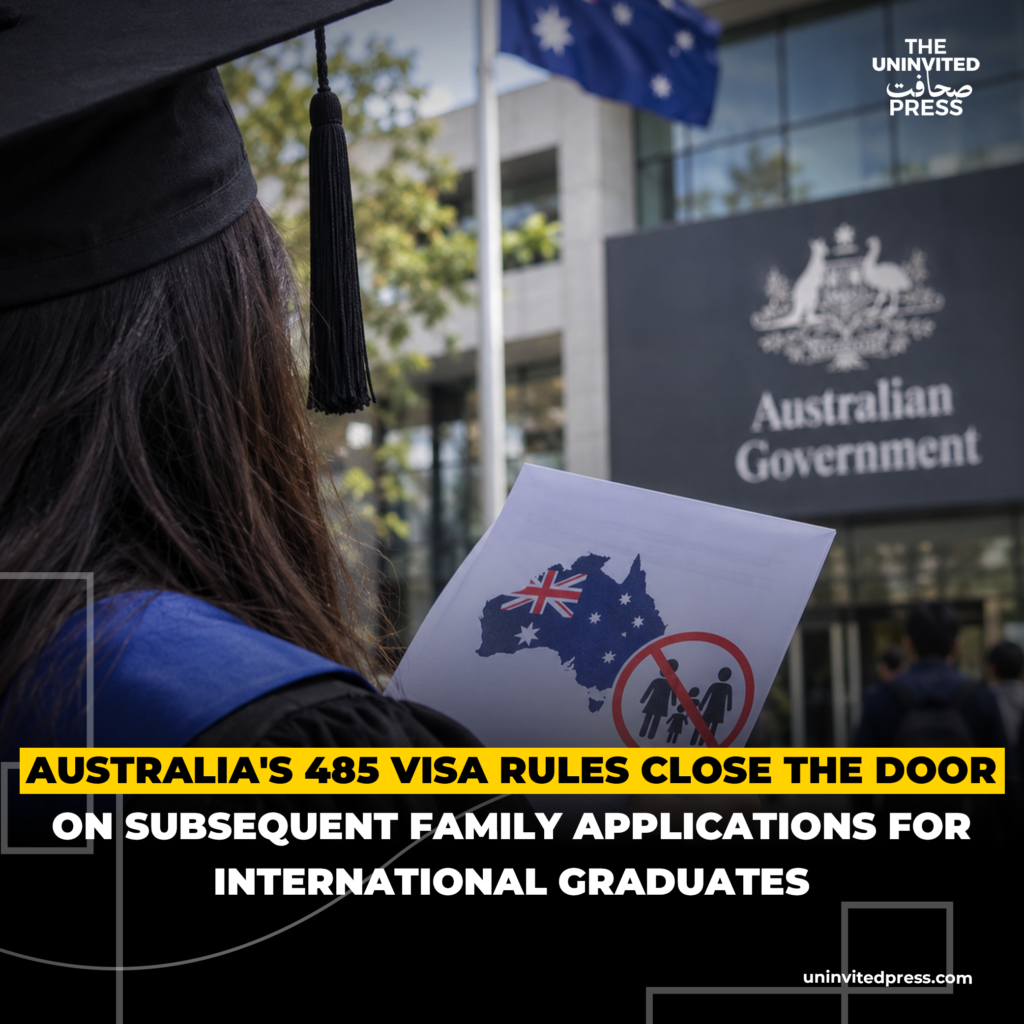
New restrictions effective 13 November 2026 limit who can join Temporary Graduate visa holders and end the pathway for partners and children to apply after the main visa is grante.
Australia has sharply restricted the ability of international graduates to bring family members under the Temporary Graduate visa (subclass 485), ending a long-standing pathway that allowed partners and children to join after the primary visa was granted. The changes, which took effect on 13 November 2026 under the Migration Amendment (Temporary Graduate Visa Reform) Regulations 2026, mean most graduates can no longer add family members as subsequent entrants. Eligible family members must now apply at the same time as the main applicant in a single combined application-and only in narrowly defined circumstances.
The Temporary Graduate visa has long served as a post-study work bridge for international students who complete Australian qualifications. It allows recent graduates to gain local work experience before potentially pursuing longer-term skilled migration options. Until the new rules, family members could generally be included at the time of application or apply later as subsequent entrants from inside or outside Australia. That flexibility has now been removed for applications lodged on or after 13 November 2026.
Under the updated rules, a partner or dependent child can only be included as a secondary applicant if at least one of six specific situations applies. These include cases where the main applicant holds a passport from a Pacific-regional country or certain ASEAN nations (Brunei, Cambodia, Indonesia, Laos, Malaysia, Myanmar, the Philippines, Singapore, Thailand or Vietnam); the graduate has completed a doctoral degree on their most recent student visa; their studies were fully funded by a foreign government; the child was born after the graduate’s most recent student or 485 visa was granted; or the family member was already included as a dependant on the graduate’s previous student visa or 485 (subject to defined time windows, including holding or having held the relevant visa on 2 October 2026 or within the preceding six months). Even in these cases, applications must be combined and lodged together. Separate subsequent entrant applications are no longer available.
Australia Tightens Family Eligibility Rules for Temporary Graduate Visas:
The primary applicant must be in Australia (and not in immigration clearance) when lodging. Secondary applicants may be inside or outside the country, provided they are not in immigration clearance, and those applying onshore generally need a substantive visa or certain bridging visas. Applications lodged before 13 November 2026 continue to be assessed under the previous rules.
Government statements and the explanatory materials accompanying the regulations frame the changes as reinforcing the original purpose of the Temporary Graduate visa: providing recent international graduates with an opportunity to gain Australian work experience rather than serving as a broader family migration pathway. The reforms follow earlier restrictions on family members attaching to student visas that took effect in early October 2026. Officials have indicated that families already in Australia as dependants on student or Temporary Graduate visas would not be separated.
For many international graduates-particularly those from countries outside the Pacific and ASEAN exemptions, or who did not complete a PhD or receive foreign-government funding-the practical effect is significant. Graduates who planned to settle temporarily with partners or children after finishing their studies now face a more constrained set of options. Those whose family members were already on previous visas as dependants retain a clearer path to inclusion, provided they meet the timing and combined-application requirements. Newborn children born after the relevant previous visa grant also remain eligible under the specific exception.
The changes form part of a broader recalibration of Australia’s international education and temporary migration settings. Higher application charges for the 485 visa earlier in 2026, alongside tighter rules on onshore student visa applications by Temporary Graduate holders, have already altered the landscape. Migration agents and education providers have noted that the family restrictions close one of the more flexible elements of the post-study pathway, potentially influencing decisions by prospective students about whether, and with whom, to study in Australia.
Australia Closes Pathway for Adding Family to 485 Visas:
Critics of successive tightening measures have argued that such restrictions risk reducing Australia’s attractiveness as a study destination, particularly for students from major source countries who often travel with or later reunite with partners and children. Supporters of the reforms counter that clearer boundaries help manage net migration, protect the temporary character of the graduate visa, and align it more closely with the student visa settings introduced weeks earlier.
For those already holding a 485 visa granted under the old rules, the ability to add family members later has effectively ended for new applications. Graduates considering a second Temporary Graduate visa in the Subsequent Post-Higher Education Work stream face the same combined-application and eligibility constraints. Prospective applicants are being advised to carefully check whether any of the six exceptions apply before lodging and to ensure all eligible family members are included in the initial combined application, as later additions are no longer possible under the new framework.
The Department of Home Affairs has published guidance confirming the new eligibility and lodgement requirements. As with many migration policy shifts, the full effects on application volumes, family decision-making, and Australia’s international education sector will become clearer in the months ahead. For international graduates who completed their studies with the expectation of flexible family reunification options, the door that once allowed subsequent applications has now largely closed.