

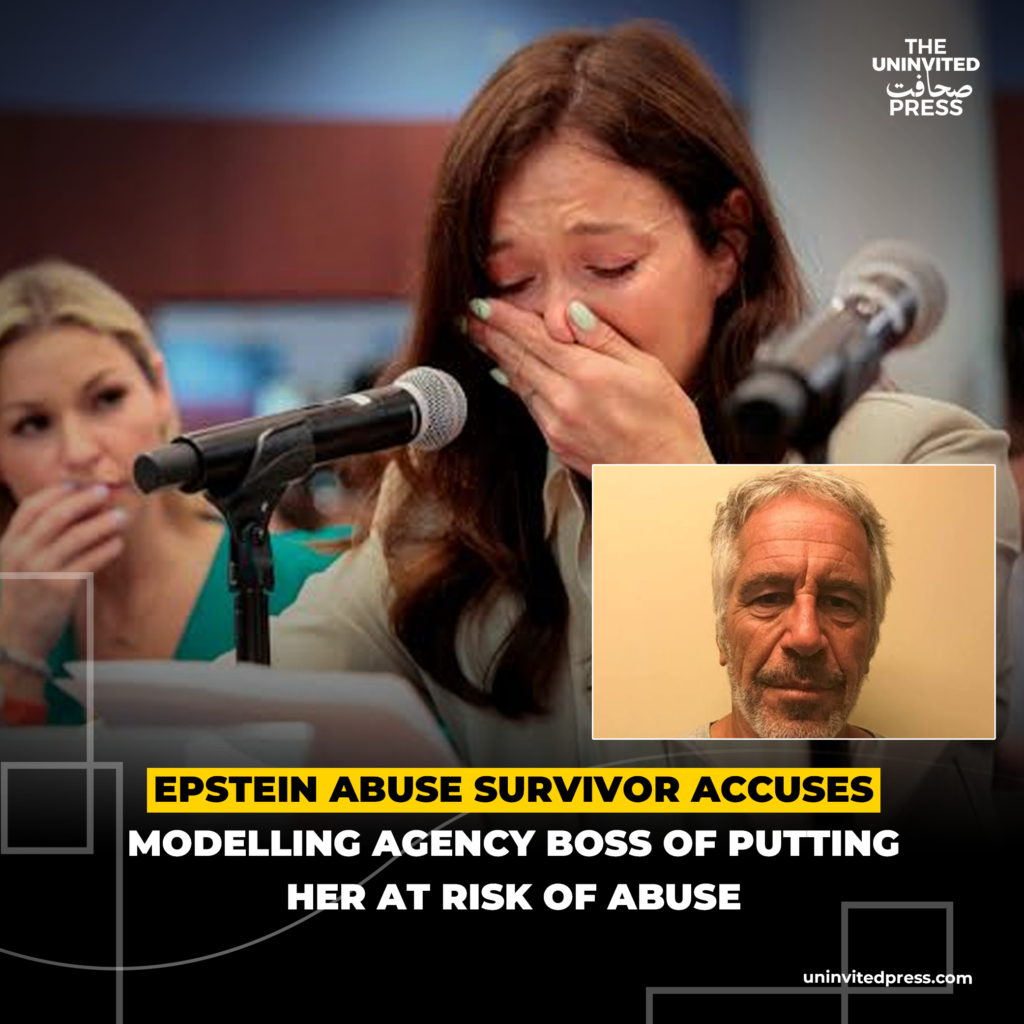
Uzbek model says MC2 president sent her to convicted sex offender’s home for staged photoshoots while he was on work release, leading to years of rape.
A survivor of Jeffrey Epstein’s sexual abuse has accused the former president of a major modelling agency of knowingly placing her in danger by sending her to the convicted sex offender’s Florida home for photoshoots in 2009, while Epstein was serving a jail sentence but allowed to work from his residence during the day.
Roza, who uses only her first name publicly for safety reasons and has previously been identified in some reports as Roza Gilles, was 18 and had arrived in the United States from Uzbekistan only about a month earlier when MC2 Model Management’s US branch dispatched her to Epstein’s Palm Beach mansion. At the time, Epstein was under a work-release arrangement following his 2008 conviction for sex offences involving a minor.
“My agency’s job was to protect me, and they failed. In fact, they put me in danger. And for that, they should be held accountable,” Roza made the statement in an interview published on Tuesday.
Modelling Agency’s Alleged Links to Epstein Under Scrutiny:
The agency’s US president at the time was Jeff Fuller. He now runs another modelling firm, The Source Models. Roza said the agency knew precisely where she was being sent. She produced an expense statement indicating that Fuller himself arranged her return flight from Palm Beach after a second shoot at the property. Fuller has previously denied knowing she was going to Epstein’s house and has said he was unaware of any abuse.
Roza described the photoshoots as strange and poorly organised. The person behind the camera was not a professional photographer but Nadia Marcinko, then Epstein’s girlfriend. There was no stylist, and the images were never used. She has since concluded the sessions were stage-managed. The shoots led to her being taken on as an assistant to Epstein, a role that other survivors have described as a common pretext Epstein used to continue abusing young women. Roza said Epstein then systematically raped her.
MC2 was founded with significant financial support from Epstein. Documents released by the US Department of Justice show he provided $1 million to the agency in 2005, even though agency figures later publicly claimed he had no involvement. The same files indicate that at least 10 models from MC2 met or communicated with Epstein after his conviction. A month after Epstein’s 2019 arrest, the US branch of MC2 was dissolved and Fuller launched The Source Models, transferring about 50 models from the old agency.
An email from Fuller to Epstein in 2012 further illustrates the relationship. Referring to another model, Fuller wrote: “Had it not been for you, we would have fired her months ago… And I would be careful as she blabs about things.”
Survivors Call for Accountability Over Epstein’s Modelling Network:
Roza’s account forms part of a broader pattern documented by survivors and investigators in which modelling agencies and scouts allegedly served as pipelines that delivered young, often financially vulnerable women-many from Eastern Europe and other regions-into Epstein’s orbit. French modelling agent Jean-Luc Brunel, a close Epstein associate who co-founded MC2 and later died in custody while facing charges, played a central role in recruiting models, including Roza.
Other industry figures named in recent reporting and Department of Justice files include former agent Ramsey Elkholy, who the Media said tried to connect dozens of women to Epstein, and Faith Kates, longtime head of Next Management, who has denied knowing of any abuse and whose lawyers described her as having been “grossly misled” by Epstein.
Sara Ziff, founder of the Model Alliance advocacy group, which campaigns for better protections for models, said agencies frequently act as the critical link. “Often, (model agencies) are the problem. They are the link between the model and these predatory men.”
New York State Senator Zellnor Myrie has proposed legislation aimed at giving authorities greater tools to investigate alleged enablers in sex-trafficking cases. He told the Media that those who sent models to Epstein knowing-or who should have known-what he was doing “will be held accountable.”
Roza has previously testified about the abuse, including before a congressional hearing, describing how she was recruited with promises of a modelling career, placed under heavy debt and control by the agency, and then delivered into Epstein’s hands while he was still under the work-release terms of his sentence. She has called on other survivors to come forward.
“There are many, many survivors out there who never speak, because it’s scary. So to all my sister survivors… you know me now. You know my name. I say, reach out.”
The modelling industry’s historical lack of labour protections, combined with the power imbalance facing young aspiring models-especially those far from home and dependent on agencies for visas, housing and work-created conditions that Epstein and his associates exploited for years. Survivors and advocates continue to press for formal investigations into the role of agencies and executives, arguing that accountability must extend beyond the primary perpetrators to the systems that facilitated access.