

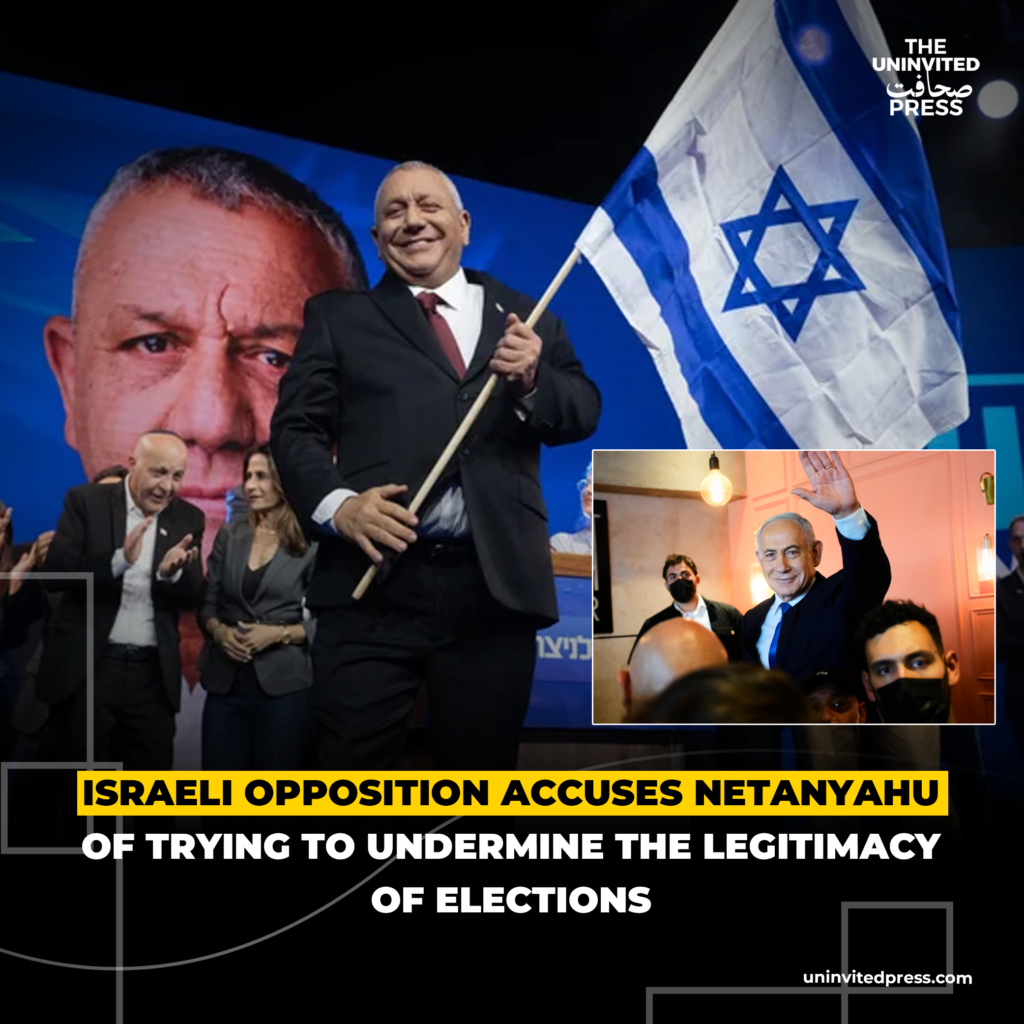
Gadi Eisenkot and Arab party leaders denounce claims of fraud and foreign interference as a coordinated campaign to invalidate results after Likud loses majority.
Israeli opposition leader Gadi Eisenkot and leaders of Arab-led parties have accused Prime Minister Benjamin Netanyahu of launching a coordinated campaign to delegitimise the results of this week’s parliamentary election after his right-wing bloc fell short of a governing majority.
Netanyahu’s Likud party claimed the election was “stolen” by Arab parties through alleged bribery, threats, violence, forgery and the use of prohibited software to mobilise voters. The party also pointed to suspicions of foreign interference, prompting Israel’s domestic security agency, Shin Bet, to open an investigation into possible illegal funding linked to Qatar and Turkey.
Qatar’s foreign ministry rejected the accusations as “ridiculous and dangerous” and accused Israeli politicians of running a disinformation campaign against Doha.
Netanyahu Faces Backlash Over Election Legitimacy Claims:
Eisenkot, a former military chief who leads the main opposition bloc, said after being briefed on the probe that it was “too early to determine what happened, or if anything happened at all.” He accused Netanyahu and Likud of running “an orchestrated and organized campaign to delegitimize the election results.”
“They are doing this because they lost,” Eisenkot stated, adding that he would not allow any delay in the swearing-in of the new Knesset.
Yair Golan, head of the Democrats party, described Netanyahu’s actions as “an ugly delegitimization campaign directed against the will of the public-and against the Arab public in particular.”
Arab party leaders strongly rejected the claims. Ahmad Tibi of the Joint List said Netanyahu was conducting “an orchestrated, toxic campaign” aimed at preventing Eisenkot from forming a government that might rely on external support from Arab parties. Sami Abu Shehadeh of Balad called the allegations “a racist blood libel,” while Ra’am leader Mansour Abbas said his party had no connection to any wrongdoing and urged a full investigation, describing Netanyahu’s rhetoric as an “incitement campaign against Arab citizens.”
Preliminary final tallies showed Netanyahu’s bloc with 53 seats in the 120-member Knesset, Eisenkot’s bloc with 48, and the two main Arab-led lists securing a record 19 seats combined. Neither major Jewish-led bloc has a clear path to the 61 seats needed for a majority without some form of cooperation involving the Arab parties, which primarily represent Palestinian citizens of Israel.
Israel Election Dispute Deepens as Officials Reject Fraud Claims:
Israel’s Central Elections Committee stated that, to its knowledge, there was “no basis for claims of systematic violation of the purity of the elections.” Officials noted that no significant problems compromising the vote’s integrity were reported on election day or immediately afterward. Police sources have similarly dismissed broader claims of widespread fraud.
Critics argue that Netanyahu’s strategy is designed to make it politically toxic for the opposition to work with Arab parties, thereby blocking any alternative government and potentially delaying the transfer of power. Netanyahu remains in a caretaker role pending the formation of a new coalition.
The dispute has intensified political tensions in the immediate aftermath of the vote, highlighting deep divisions over the role of Arab parties in Israeli politics and raising questions about the acceptance of electoral outcomes. Investigations into the foreign interference claims are ongoing, with results expected in the coming days.