

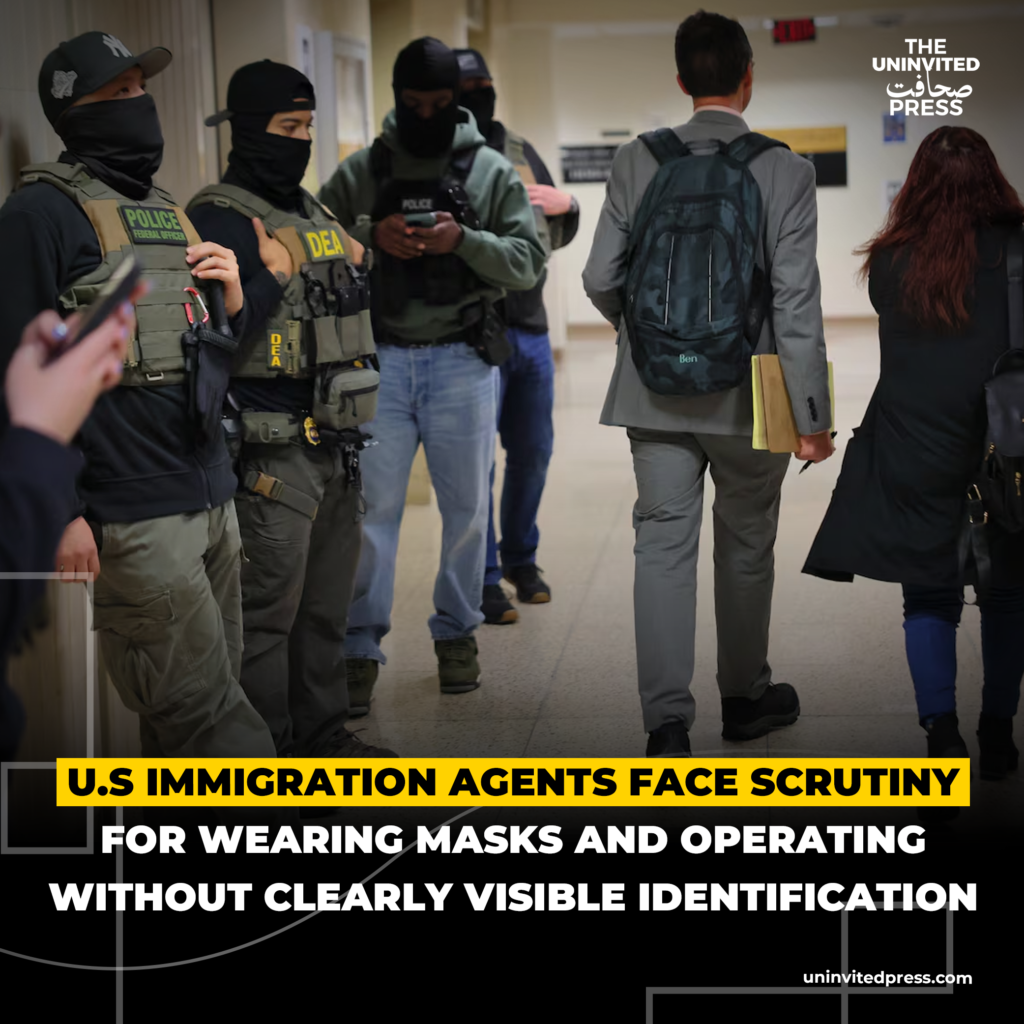
Practice of covering faces during raids and arrests draws criticism for eroding accountability and public trust amid expanded enforcement operations.
United States immigration enforcement agents have come under increasing scrutiny for routinely wearing masks and operating without clearly visible personal or agency identification during arrests and raids, a practice that has become a defining visual of the current administration’s aggressive deportation campaign.
Videos circulating widely since early 2025 show agents from Immigration and Customs Enforcement (ICE), Customs and Border Protection and other Department of Homeland Security (DHS) components approaching people on streets, outside courthouses, at workplaces and near homes while wearing balaclavas, neck gaiters, sunglasses or other face coverings. Many operate in plain clothes or tactical gear from unmarked vehicles, sometimes with limited or no clear insignia identifying their agency or individual badge numbers.
Critics, including civil rights organisations, former law enforcement officials and Democratic lawmakers, argue the tactics create fear, sow confusion and undermine accountability. Supporters within the administration maintain the measures are necessary to protect officers and their families from doxxing, online harassment and physical threats in a polarised climate.
Masked ICE Agents Spark US Debate Over Safety and Accountability:
DHS and ICE officials have consistently defended the practice. They say agents face heightened risks of being identified, tracked online and targeted, including threats to their families. Officials have cited sharp increases in assaults and doxxing incidents targeting immigration officers since the expansion of interior enforcement operations.
“I’m not going to let my officers and agents go out there and put their lives on the line, their family on the line because people don’t like what immigration enforcement is,” ICE acting director Todd Lyons has said. DHS Assistant Secretary for Public Affairs Tricia McLaughlin has emphasised that agents wear vests marked “ICE” or “ERO,” verbally identify themselves and operate alongside marked vehicles in many cases. Federal regulations require immigration officers to identify themselves as such “as soon as it is practical and safe” to do so.
Civil liberties groups and some former officials describe the widespread masking as atypical for US law enforcement outside specialised undercover or high-risk tactical operations. They note that agents historically made high-profile arrests of major organised crime figures without covering their faces.
“It raises the question, if they are legitimate law enforcement agents carrying out a proper arrest under the law, why are they hiding their identities?” CNN law enforcement analyst John Miller has observed. Former FBI agent Mike German has called the trend “absolutely shocking and frightening,” arguing it symbolises a drift away from democratic oversight of policing.
Human Rights Watch has said the indefinite and widespread use of masks and lack of visible identification is “fundamentally inconsistent” with obligations to ensure accountability for potential abuses. Community advocates report that masked, poorly identified agents heighten panic in immigrant neighbourhoods and make it harder for bystanders or those being detained to distinguish legitimate officers from possible impersonators. Isolated cases of people posing as ICE agents have been reported.
A federal judge, in a ruling critical of related enforcement practices, described the masking as designed “to terrorize Americans into quiescence” and stated that the United States has never tolerated “an armed masked secret police.”
US Moves to Restrict Masked ICE Agents:
Several cities and states have sought to restrict the practice. Ordinances or laws in places including St. Paul, Minnesota; Denver; and California have aimed to ban face coverings that obscure identity for law enforcement officers conducting arrests or detentions and to require visible agency and personal identification. The Department of Justice has sued multiple jurisdictions, arguing that local rules unconstitutionally interfere with federal operations and officer safety. Similar legal challenges are ongoing.
Democratic senators have introduced federal legislation that would prohibit non-medical face coverings by immigration officers and mandate visible name or badge numbers and agency identification during enforcement actions.
The debate unfolds against the backdrop of a major expansion of interior immigration enforcement under the Trump administration. High-profile arrests, including that of Turkish graduate student Rümeysa Öztürk in Massachusetts in 2025, brought early attention to the use of masked plainclothes agents. Similar scenes have since become common in multiple cities.
While federal officials insist agents remain identifiable through verbal announcements, markings and vehicles, critics maintain that the combination of face coverings, plain clothes and limited visible identifiers creates an appearance of anonymity that is incompatible with transparent, accountable policing in a democratic society. The legal and political battle over the practice continues in courts and legislatures across the country.