

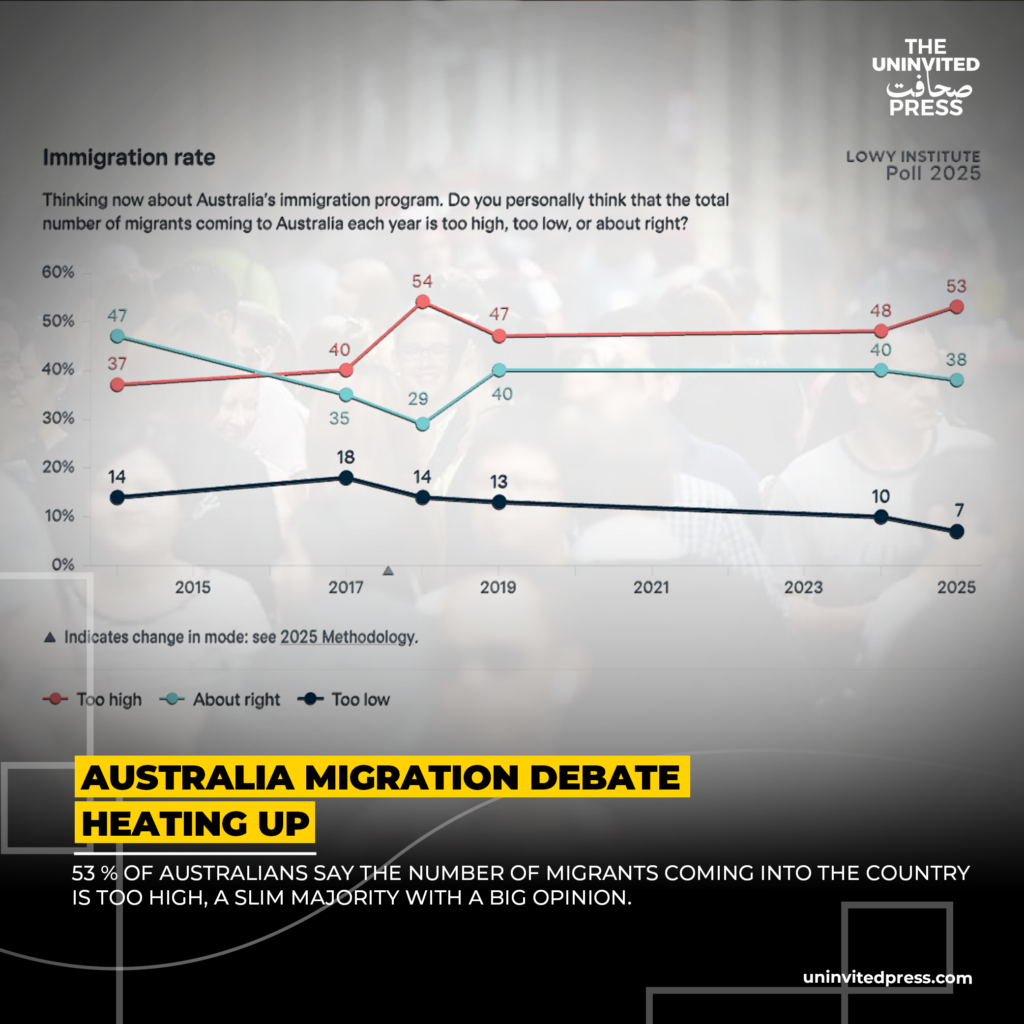
Lowy Institute findings reveal shifting public sentiment, fueling calls for tighter controls amid housing and economic pressures. Public opinion shifts amid housing crunch and economic strains, pressuring policymakers to rethink intake levels.
Australians Turn Against High Migration: 53% Now Say Numbers Are Too High:
A slim majority of Australians-53%-now believe the nation’s annual migrant intake is too high, according to the freshly released 2025 Lowy Institute Poll, marking a five-point jump from last year. This surge in concern arrives as net overseas migration dips but remains robust at over 300,000, fueling debates over housing affordability and infrastructure overload. With the Albanese government holding firm on its migration program after a 2025 election win, this divide signals potential policy battles ahead that could reshape Australia’s multicultural fabric.
53% of Australians Now Say Migration Is Too High-Lowy Poll 2025 Reveals Growing Backlash:
The 2025 Lowy Institute Poll, a cornerstone of Australian opinion tracking for two decades, posed a straightforward question: “Do you personally think that the total number of migrants coming to Australia each year is too high, too low, or about right?”
The response: 53% said too high, a climb from 48% in 2024 and a stark reversal from the 29% low in 2022 during border closures. Those deeming levels “about right” fell to 38%, while just 7% called them too low. This data, visualized in a line graph spanning 2015 to 2025, shows peaks in anti-migration sentiment aligning with economic downturns and policy shifts.
Released amid a heated post-election landscape-Labor secured a second term in May 2025-the poll underscores a public mood swing. Net overseas migration, per Australian Bureau of Statistics figures from December 19, 2025, stood at 306,000 for the 2024-25 financial year, down 29% from 429,000 the prior year but still elevated. Arrivals totaled 568,000, with temporary visas dominating at 363,000.
The government announced on September 2, 2025, that the permanent Migration Program would hold steady at 185,000 places for 2025-26, prioritizing the Skill stream at 132,200 spots to address labor gaps in healthcare, construction, and tech. This continuity follows Labor’s election promises to balance economic needs with community concerns.
The timeline reveals tensions. Protests erupted in September 2025 across cities, with demonstrators demanding cuts amid perceived links to housing woes. By November, social media buzzed with debates, including posts highlighting “record high immigration” impacts on quality of life.
Context and Background:
Australia’s migration narrative is rooted in post-World War II expansion, evolving from the restrictive White Australia Policy-dismantled in 1973-to a points-based system favoring skills and family ties. By the 1990s, it became a economic driver, contributing to 33 years of uninterrupted growth until COVID-19. The pandemic halted inflows, but reopening in 2022 sparked a boom; net migration hit 538,000 in 2022-23, the highest on record. This surge, intended to fill workforce voids, collided with a housing crisis-rents soared 14% nationally in 2024, per CoreLogic data-and inflation peaks.
Public sentiment, as charted by Lowy since 2005, has fluctuated; highs of 54% “too high” in 2018-19 amid urban congestion debates, dipping during isolation. The 2025 spike reflects ongoing strains, with 31.5% of residents foreign-born as of June 2024, totaling 8.6 million. It accounts for 80% of population growth, projected to hit 28 million by 2026. Yet, unchecked, it risks social cohesion, as seen in rising anti-immigration rhetoric.