

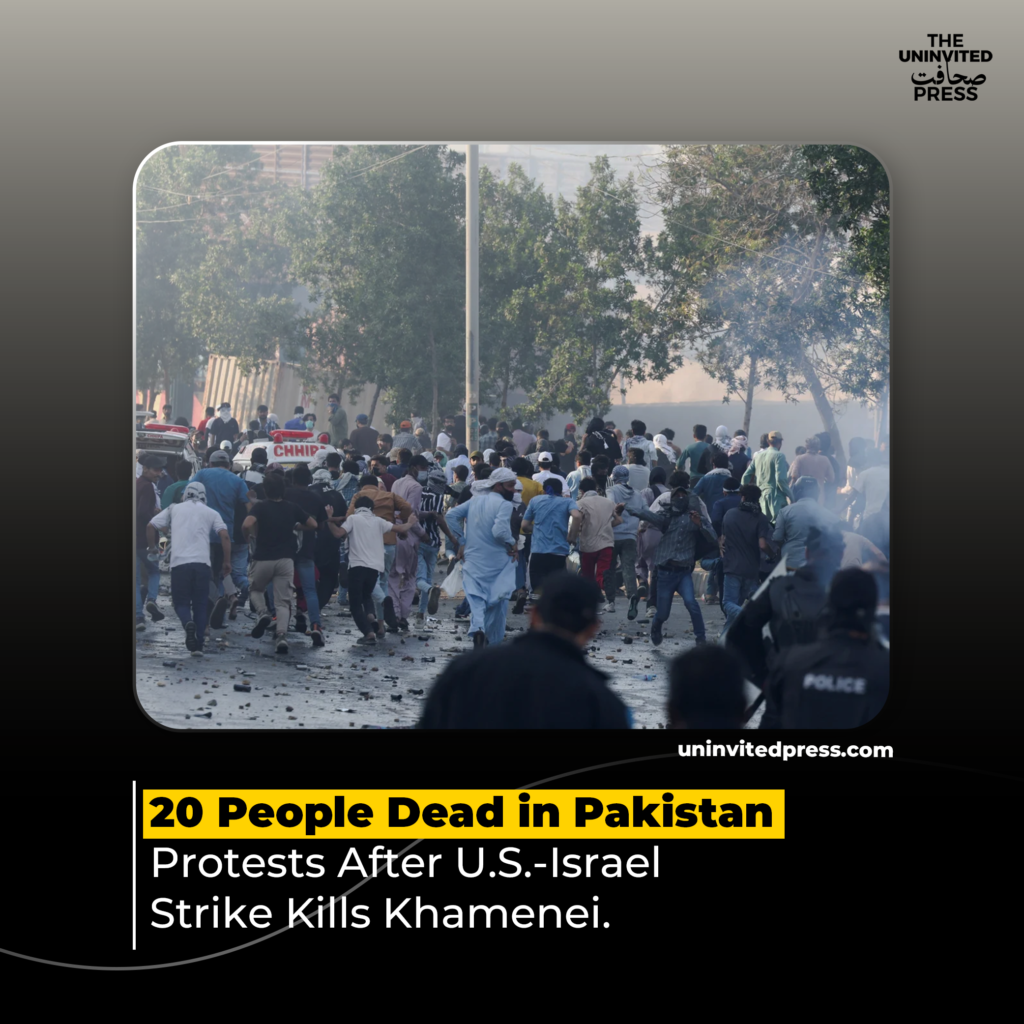
At least 23 dead and 120 injured in Pakistan protests over U.S.-Israel strikes killing Iran’s Khamenei, with clashes at U.S. consulate in Karachi sparking national unrest.
Pakistan Gripped by Fatal Protests After Iran Strike:
Deadly violence swept across Pakistan on March 1, 2026, leaving at least 20 protesters dead and more than 120 injured in clashes with security forces. The unrest erupted in response to the U.S.-Israeli military strikes that killed Iran’s Supreme Leader Ayatollah Ali Khamenei two days earlier, with crowds targeting American diplomatic facilities and chanting against the West. This outbreak underscores the volatile spillover of Middle East conflicts into South Asia, where sectarian ties to Iran run deep, potentially destabilizing Pakistan’s fragile security landscape and straining international relations.
As funerals for the victims commenced early on March 2, authorities placed hospitals on high alert and urged restraint, amid warnings that the protests could intensify. The human toll adds a grim layer to the already escalating global fallout from the strikes.
Deadly Protests Erupt Across Pakistan After Khamenei Strike:
The protests ignited shortly after Iranian state media confirmed Khamenei’s death on February 28, 2026, following joint U.S.-Israeli airstrikes on Tehran. By midday on March 1, hundreds gathered outside the U.S. consulate in Karachi, chanting slogans like “Death to America” and “Death to Israel” while waving Iranian flags. The crowd breached the outer perimeter, breaking windows and setting a small fire in the reception area, according to eyewitness accounts and video footage.
Security forces responded with tear gas and batons, but as the situation escalated, reports indicate live rounds were fired, resulting in at least 10 deaths in Karachi alone. Similar scenes unfolded in northern Pakistan, where protesters in Skardu torched a U.N. office, leading to 11 fatalities, and in Gilgit, where clashes claimed additional lives. In Islamabad, two protesters died amid demonstrations near government buildings.
Medical officials reported treating gunshot wounds and injuries from blunt force, with some victims in critical condition. By evening, the violence had spread to Lahore, though with fewer casualties reported.
Overnight into March 2, thousands attended funeral prayers in Karachi for the deceased, as confirmed by local media. The total death toll climbed to 20, with injuries exceeding 120 across the country.
Sectarian Tensions in Pakistan Surge After Khamenei’s Death:
Pakistan, home to a significant Shiite minority-estimated at 20-25% of its 240 million population-has long-standing cultural and religious ties to Iran. Khamenei, as a prominent Shiite cleric and Iran’s leader since 1989, was revered by many in this community, making his death a profound trigger for grief and outrage.
The protests fit into a history of sectarian unrest in Pakistan, where anti-Western demonstrations have previously turned violent, such as after the 2020 U.S. killing of Iranian General Qasem Soleimani. Recent months have seen Pakistan strengthen security ties with Saudi Arabia, Iran’s rival, which may have heightened internal divisions over the Khamenei incident. The strikes on Iran, which also caused civilian casualties there, have amplified global Shiite solidarity, with similar protests in Iraq, Lebanon, and India.